Cryptocurrency Exchange Development Services

At Prostrive, we build custom centralised, decentralised, hybrid, P2P and OTC exchanges as part of our FinTech software development services. We work for businesses launching a new crypto exchange or rebuilding one they've outgrown. Our engineers join your team, you own the code, and we design the platform around EU and UK rules at every stage.

Let's talk
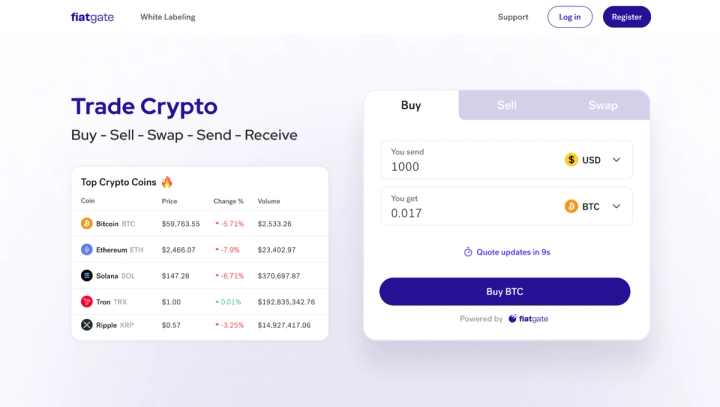
FiatGate white-label crypto exchange built by Prostrive, an example of cryptocurrency exchange development

Custom Build or White-Label Crypto Exchange Software?

A white-label script is the fastest way to get crypto exchange software live. A custom build makes sense when your exchange has to work differently from the rest. With a script or white-label licence, you get ready-made modules under your own brand: an order book, wallets, a KYC flow and an admin panel.

The trade-off shows up later. Licence fees keep running, and the vendor owns the matching engine and the data model. Compliance changes wait on their roadmap, and the code is never yours.

Building from scratch pays off when the exchange itself is your edge. Think of a custody model a cryptocurrency exchange script doesn't support, or integrations with your own banking or card infrastructure. With a custom build, the code and the intellectual property are yours.

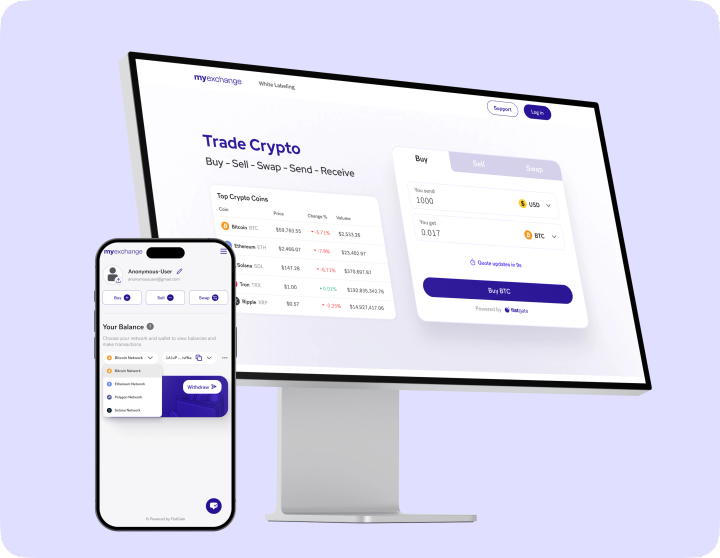
Of course, someone has to build white-label platforms too. We built FiatGate, a white-label non-custodial exchange that its operator now offers to other businesses under their own brand.

We don't sell a script or a ready-made exchange. If you need a standard exchange live quickly and your edge is distribution, a licensed white-label will probably serve you better. We'll tell you so in a Discovery call.

Cryptocurrency Exchange Development Services by Exchange Type

Choosing an exchange type is a business-model decision before it's a technical one. It decides who holds your users' assets, where liquidity comes from and which licence you need. That's why our cryptocurrency exchange development services start with this choice, and the feature list comes later.

Centralised Exchange (CEX) Development

A centralised exchange (CEX) matches buy and sell orders in its own order book, and the operator holds users' funds. That custody role brings the heaviest regulatory load: full KYC and AML checks, fiat access through banking partners and strict withdrawal controls. Our CEX builds centre on the matching engine, wallet security and the compliance flows around them.

Decentralised Exchange (DEX) Development

A decentralised exchange (DEX) settles trades on-chain through smart contracts, using automated market makers or an on-chain order book. Users keep their own keys, so custody moves away from you and the smart contracts become the product. So independent audits belong in the plan before launch. Our DEX components run on Ethereum and Solana.

Hybrid Exchange Development

A hybrid exchange combines off-chain order matching for speed with on-chain settlement or self-custody for transparency. The hard part is keeping both states consistent, so the balance a user sees always matches what the chain records. Hybrid exchange development suits operators who want CEX performance without holding every user's funds themselves.

P2P Exchange Development

A peer-to-peer (P2P) exchange lets buyers and sellers trade directly, with the platform holding funds in escrow until both sides confirm. Users judge a P2P platform on payment-method matching, dispute handling and fraud prevention. These builds put trust controls ahead of trading speed.

OTC Trading Platform Development

An over-the-counter (OTC) trading platform handles large trades outside the public order book for institutional and high-net-worth clients. Quoting, settlement and counterparty checks matter more here than matching speed, and every deal needs a clear audit trail. OTC platform development focuses on request-for-quote flows, settlement and reporting.

Cryptocurrency exchange development dashboard
What We Build

What We Build Into a Cryptocurrency Exchange Platform

Cryptocurrency exchange platform development covers far more than the trading screen. The decisions that make or break an exchange sit in the systems around it: the custody model, liquidity on launch day and user onboarding.

  • Trading and Matching Engine

    The trading and matching engine matches buy and sell orders, supports market, limit and stop orders, and streams live prices to users over WebSockets. It's event-driven, with Kafka and Redis Streams carrying orders and market data. That's the same pattern behind the real-time pipelines in Ampang, the AI crypto trading bot we built.

    Let's talk
  • Wallet Custody Model

    The wallet custody model decides who controls the private keys. That choice shapes your licence, your security burden and how much users have to trust you. In a custodial setup, we build the custody layer ourselves: custodial wallets, cold storage and multi-signature approval above set limits.

    With a non-custodial setup, users keep their keys and your exchange never holds their assets.

    Let's talk
  • Liquidity From Day One

    Liquidity is the problem new exchanges underestimate most. An empty order book means wide spreads, and early users leave before the next ones arrive. The usual answers are external liquidity providers or other exchanges, a market-making arrangement, or several sources aggregated into one order book.

    We build and test those liquidity integrations. You negotiate the commercial agreements behind them.

    Let's talk
  • KYC and AML Onboarding

    KYC and AML onboarding verifies each user's identity, screens them against sanctions lists, PEP databases and adverse media, and keeps monitoring transactions after signup. Our KYC software development work on FiatGate showed that designing verification and screening in from the start costs far less than retrofitting it later. Every onboarding decision leaves an audit trail your compliance team can work with.

    Learn more
  • Fiat On-Ramps and Off-Ramps

    Fiat on-ramps and off-ramps move money between bank accounts or cards and crypto. We build these ramps and crypto payment gateways ourselves, and integrate regulated providers where that route suits your licence better. Those providers can then handle the KYC and AML checks for their part of the flow, as in FiatGate.

    Payment gateway development is a service of its own, but on an exchange build, the ramps are part of the platform we deliver.

    Learn more
  • Operator Admin Panel

    The operator admin panel is where your team manages users, handles compliance cases, sets fees and trading pairs, and pulls reports. Nobody outside your team sees this part of the exchange, yet your staff work in it every day.

    Let's talk
  • Web and Mobile Trading Apps

    Web and mobile trading apps give users the same exchange on desktop, iOS and Android. We build the web interfaces in React and Next.js, and the iOS and Android apps in React Native or Flutter. All of them share one backend, built with the same care as our wider FinTech app development work.

    Learn more
Why Prostrive

Why Build Your Crypto Exchange With Prostrive

Choosing a partner to build a crypto exchange comes down to regulatory fit, security architecture and a track record with systems that move real money. Here's why clients bring their exchange projects to us.

Built Around MiCA and the UK Crypto Regime

In 2026, a crypto exchange must be built around authorisation requirements, or it can't operate. In the EU, MiCA authorisation for crypto-asset service providers has applied since 30 December 2024. The national transitional periods ended on 1 July 2026 at the latest, so serving EU clients now requires MiCA authorisation.

The UK follows on 25 October 2027, when operating a cryptoasset trading platform becomes an FCA-regulated activity. FCA applications open on 30 September 2026 and close on 28 February 2027. Until the new regime starts, firms register with the FCA under the Money Laundering Regulations.

We design KYC and AML data, travel-rule information, record-keeping, client-asset segregation and supervisory reporting into the platform. The licence application sits with your compliance team and legal advisers.
Security Decided in the Architecture

Crypto exchange security comes down to architecture: how you hold keys, how withdrawals get approved and who can change what. Hot wallet balances stay capped, the rest sits in cold storage, and large withdrawals need multi-signature approval. Role-based access with audit logs and two-factor authentication protect user and admin accounts alike.

We encrypt data in transit and at rest, while DDoS protection and rate limiting guard the public endpoints. Penetration testing happens before launch, along with smart contract audits for on-chain components. Monitoring carries on after it.

Custody Experience From a Live Non-Custodial Exchange

FiatGate is a white-label non-custodial wallet and exchange platform we built for an operator that offers it to other businesses under their own brand. Users buy, sell and swap crypto through integrated, regulated on-ramp and off-ramp providers and keep their own keys. Building FiatGate showed us how one custody decision reshapes the onboarding flow and the split of compliance duties.

Exchange API Integration in Production

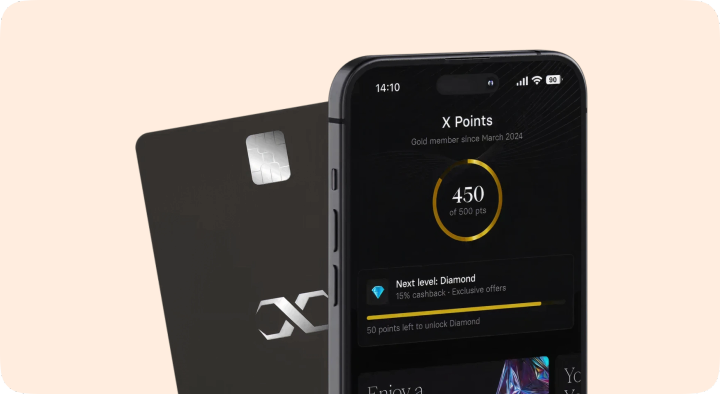
Ampang, an AI crypto trading bot, connects to Binance, Coinbase Pro and Kraken. It processes their market data in real time over Kafka and WebSockets. Axys, a card platform for high-net-worth individuals, combines crypto exchange APIs with card issuing so users can top up their cards with crypto.

Integrations like these have to cope with rate limits, dropped connections and prices that differ between venues, the same conditions your exchange will face.

Experience With Licensed Payment Clients

We built the payment solutions for Globus Payments, an EMI-licensed provider serving the logistics sector from London. Working for a licensed client makes audit trails, access controls and change control part of the definition of done. A crypto exchange that has to satisfy a supervisor needs exactly that discipline.

Code and IP You Own

On a custom build, you own the code and the intellectual property of your crypto exchange. That holds under all our standard contracts: Dedicated Teams, Team-as-a-Service and Project-Based Development. No ongoing licence ties you to us, and if you bring development in-house later, the platform goes with you.

Our Process

Our Cryptocurrency Exchange Development Process

Most of the risk in a cryptocurrency exchange development process gets settled before anyone writes a line of code. So ours starts with market, licence and liquidity questions and carries on after launch.

Step 1: Discover and Define - Process illustration
Step 2: Assemble Your Team - Process illustration
Step 3: Design, Develop and Deliver - Process illustration
Step 4: Nurture and Evolve - Process illustration
Build your team
Technologies

Our Crypto Exchange Tech Stack

Each part of our crypto exchange tech stack solves a specific exchange problem. Kafka and Redis Streams carry order and market-data events, WebSockets push live prices to users, and Node.js and Python run the services behind them.

React and Next.js power the web interfaces, React Native and Flutter the mobile apps. Docker, Kubernetes and AWS let the platform scale with trading volume, and on-chain components run on Ethereum or Solana.

Angular
.NET
C#/C++/C
PHP
Pulumi
Databricks
Flutter
React.js
JavaScript
Docker
Kubernetes
AWS
Angular
.NET
C#/C++/C
PHP
Pulumi
Databricks
Flutter
React.js
JavaScript
Docker
Kubernetes
AWS

How Our Crypto Exchange Developers Join Your Team

An exchange is never finished, so the collaboration model that matters most keeps knowledge of your platform inside your organisation. Our crypto exchange developers work through outstaffing: we employ them, but they work in your team every day. Western on-site management in our hubs keeps quality and communication on track.

Dedicated Teams for Your Exchange

A Dedicated Team works only on your exchange and is managed directly by you. Over time, it builds deep knowledge of your trading model, codebase and compliance setup. That suits operators with a long roadmap and several workstreams running in parallel.

Team-as-a-Service for Exchange Development

With Team-as-a-Service, we manage your exchange development team, including quality assurance and delivery coordination. You set the priorities and keep full visibility, while the team scales up or down as your roadmap changes.

Project-Based Exchange Development

Project-Based Development fits a clear objective: a new exchange, an additional exchange type such as P2P or OTC, or a single integration. We agree scope and deliverables upfront, then take the project through design, build and deployment.

Global Reach

Established in 2021. Our team spans 4 countries (The Philippines, The Netherlands, Hong Kong, Armenia), delivering 100+ transformative projects across the world.

Our Work

Trusted by companies we've helped grow

A selection of the products our embedded teams have helped build.

  • Fiatgate

    FiatGate

    FiatGate is a white-label platform that lets businesses launch their own branded, non-custodial crypto wallet and exchange. We built the complete platform in JavaScript, with third-party APIs for wallet management and exchange functionality.

    Read the case study
  • Axys Holding

    Axys

    Axys provides card solutions for high-net-worth individuals, with crypto top-up of the card balance. We delivered the web development behind the platform.

    Read the case study
  • Ampang

    Ampang

    Ampang is an AI crypto trading bot built for cross-exchange trading in volatile markets. Its real-time pipelines run on Kafka, Redis Streams and WebSockets and connect to Binance, Coinbase Pro and Kraken through rate-optimised APIs.

    Read the case study
View all case studies

Plan Your Exchange Build With a Discovery Call

A Discovery call settles your exchange type, build route and regulatory scope before you commit any budget. Tell us what you want to launch, and we'll walk through the architecture, the custody model and the integrations your exchange needs.

FAQs

Frequently Asked Questions About Cryptocurrency Exchange Development