Full-Cycle Development Under One Roof
Architecture, backend and frontend, UI/UX design, DevOps and QA sit in one team. You don't have to coordinate a design agency, a development shop and an infrastructure contractor around a live trading system.
As part of our FinTech software development, Prostrive builds trading software for crypto markets. That covers automated trading bots, trading analytics and dashboards, market data pipelines, and the wallet and payment rails around them.
We don't build brokerage or institutional trading platforms, and we say so up front because it saves you a call. Our developers join your team under Dedicated Teams, Team-as-a-Service or Project-Based Development, and the code and intellectual property stay with you.
Trading software is a broad term, so it helps to be precise about the products we build. All of them share the same core problem. Market data has to arrive fast and decisions have to respect limits, while orders leave through APIs that rate-limit you.
An automated trading bot turns a strategy into orders without a person placing each one. The real work is in backtesting, live execution under hard risk limits and monitoring that flags when a model starts behaving differently. Ampang, our AI crypto trading bot, runs on reinforcement learning, LSTM networks and anomaly detection.
Let's talkTraders and operators need to see positions, performance and risk while the market moves. We build analytics and dashboards that combine live prices, historical data and strategy results in one view. Alerting matters as much as charting, because someone has to notice a stalled feed or a runaway position.
Let's talkTrading data feeds are the layer everything else depends on. We ingest data from exchanges and providers, normalise it into one format, and keep it flowing through pipelines that survive reconnects and gaps. The same pipelines serve bots, dashboards and historical analysis.
Let's talkMachine learning has a clear place in FinTech AI development for trading: signal generation, anomaly detection and pattern recognition in market data. LLM-based assistants can explain positions, summarise strategy performance or answer questions inside your product. Risk limits stay outside the model, in code you control.
Learn moreTrading products rarely stop at the trade itself. We build and integrate crypto custody (custodial wallets and cold storage), fiat on-ramps and off-ramps, and crypto payment gateways. For a full exchange with its own order book, see our cryptocurrency exchange work.
Learn more
A trading brief is easier to scope when the boundaries are clear. We don't build brokerage platforms, prop firm platforms, or institutional order and execution management systems. Our automated trading work is crypto only, so equities, forex and derivatives are out.
Fraud detection is outside our scope too. AML software and transaction monitoring come into a project as tools we integrate, and we don't build them ourselves.
If your plan needs one of those, a specialist vendor will serve you better than we would. The parts we do build often sit alongside them, so a scoping call can still be worth the half hour.
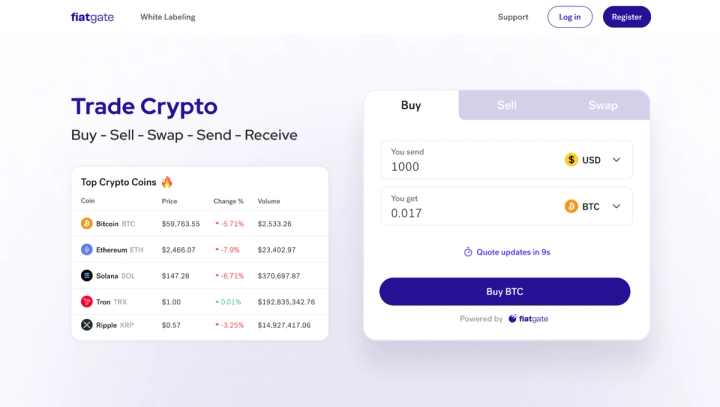
A white-label platform is the better choice when you offer a standard product and speed to market matters most. Custom trading software pays off when your edge lives in the software itself. Many firms end up somewhere in between.
The case for custom gets stronger with your own strategy logic, an unusual data mix or requirements a vendor can't model. Once licence fees overtake the cost of building, it's stronger still.
The hybrid route keeps a licensed core and adds custom layers around it. Typical layers are analytics, automation, reporting and a client portal.
We know the other side of this choice too. For FiatGate, we built a white-label, non-custodial exchange platform that lets businesses launch a branded crypto exchange without building from scratch. If a white-label product covers what you need, that's what we'll tell you.

A trading system is easiest to understand as a chain, because a weak link anywhere stops the whole thing. It starts with market data and ends with someone watching what the system does.
First comes market data ingestion, which keeps prices current and normalises feeds from several exchanges into one format. The strategy engine turns that data into decisions, with backtests behind it and hard limits in front of it. Execution sends orders through exchange APIs, where rate limits and partial fills decide how the code has to behave.
Risk controls sit between decision and execution. Position limits, exposure caps and kill switches stop a strategy that starts running away, and they belong in code rather than in a policy document.
Around that chain sit the supporting parts: wallets and custody, fiat on-ramps and off-ramps, KYC software for onboarding, and the dashboards your team uses. Each external connection has its own protocol, rate limits and failure modes, so the integration map is one of the first things we draw up.
What counts as real-time is something you define per use case. Crypto markets never close, so speed is only half the question. The other half is how the system behaves when a feed drops at three in the morning.
Data has to keep flowing when an exchange throttles, disconnects or leaves a gap in the feed. For Ampang, our team built pipelines on Kafka, Redis Streams and WebSockets that feed the strategy engine continuously. Buffering and replay matter as much as raw speed, because a lost minute of data can invalidate a decision.
Every exchange API has rate limits, and they shape the architecture more than most teams expect. Ampang connects to Binance, Coinbase Pro and Kraken through rate-optimised APIs, with retry and back-off logic for the moments an exchange pushes back. An order that fails silently is worse than one the exchange refuses.
Operators need to see what an automated system is doing while it runs. We build dashboards that show live positions, strategy state and feed health, with controls to pause or stop a strategy. Ampang's dashboard runs on Next.js, TailwindCSS and Socket.io for live updates.
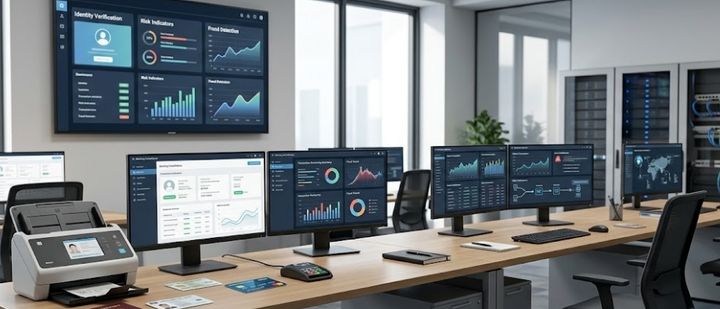
Regulation in crypto trading software lives in specific flows and data, which is why we design for it before the first sprint. We build those flows. Your firm holds the licence and remains responsible for its policies and regulatory reporting.
MiCA is the first framework to check. Crypto-asset services to EU clients have needed MiCA authorisation since the transitional period closed on 1 July 2026, and custody, on-ramps and exchange features are exactly what it covers.
Onboarding comes next. KYC and AML checks belong in the flow before a client trades, and we integrate established AML and transaction monitoring tools rather than rebuilding them.
Then there are audit trails. Every order, amendment and access event needs a record you can pull up when a regulator or auditor asks for it.
For EU financial entities, DORA has applied since 17 January 2025 and covers the risk from ICT third-party providers. That can cover an external team that builds or runs your systems, ours included, so expect due diligence, contract terms and an exit plan.
Regulated onboarding is work we've done before. Prostrive has been the technology partner of Globus Payments, an EMI-licensed payments company in London, from the start. That work includes regulation-compliant onboarding flows and API integrations with banks.
The trading systems we've built run in real time on crypto markets. Market data streams in from several venues, and decisions stay within limits before orders go out through rate-limited APIs.

Ampang is an AI crypto trading bot built for cross-exchange trading in volatile markets. Its real-time pipelines run on Kafka, Redis Streams and WebSockets and connect to Binance, Coinbase Pro and Kraken through rate-optimised APIs.
A strategy engine built with Node.js, Python and TensorFlow makes the trading decisions, combining reinforcement learning, LSTM networks and anomaly detection. Everything runs as containerised microservices on Docker and Kubernetes. A dashboard built in Next.js, TailwindCSS and Socket.io gives operators live monitoring and control.
Read the case study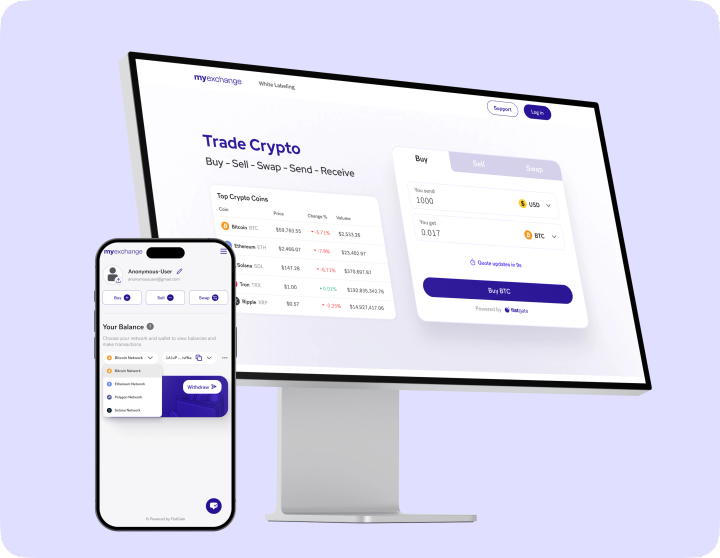
FiatGate is a white-label platform that lets businesses launch their own branded, non-custodial crypto wallet and exchange. Our team built the complete platform in JavaScript, with third-party APIs for wallet management and exchange functionality. Its modular design lets each partner add its own branding and extra features.
Read the case studyTrading firms need a partner whose way of working fits a system that handles live money. Here are the reasons that hold up when you look closely.
Architecture, backend and frontend, UI/UX design, DevOps and QA sit in one team. You don't have to coordinate a design agency, a development shop and an infrastructure contractor around a live trading system.
Our co-founders think about your product and market as well as the code. That matters when a technical choice is really a business decision, such as which exchanges or markets to support first.
You own the code and the intellectual property of what we build, under every collaboration model. So there's no lock-in if you later bring development in-house.
Our developers join your standups and Slack channels, so you talk to them directly instead of through a ticket queue. Western management on-site in our hubs, plus cultural workshops and communication training, keeps delivery standards consistent.
Remote developers in Asia and Armenia give you a structurally lower cost per line of code, while Western management keeps a close eye on quality. More of your funding goes into the product instead of overhead.
You can scale the team up for a major release and back down afterwards. There are no long-term contracts, so the engagement follows your roadmap rather than a notice period.
When a trading system fails under pressure, it's usually in the data and execution layers. So we build and test those before the interface, and each phase ends with a decision for you to make.
We choose technologies for performance and for handling many real-time data streams at once. Backend services run on Node.js and Python, interfaces and dashboards on React and Next.js, and mobile apps on React Native or Flutter. TensorFlow powers the machine learning components, Kafka and Redis Streams carry real-time data, and Docker and Kubernetes on AWS handle deployment and scaling.
The right model depends on how much of the build you want to steer yourself. All three are forms of outstaffing: our developers become part of your team instead of working out of sight on a separate project. Whichever you choose, the code and IP are yours.
A Dedicated Team reports directly to you and stays on your product. It suits firms with a continuous roadmap, because the team builds up the kind of knowledge that only comes from working on one system over time.
With Team-as-a-Service, we manage the team, the sprints and delivery, while you set direction and review the results. It fits firms that need extra engineering capacity for a busy period, such as a new exchange integration or a regulatory deadline.
Project-Based Development suits a clearly defined scope, such as a trading bot, an analytics dashboard or a data pipeline. We take care of architecture, design, development, testing and deployment within the agreed scope and timeline.
Established in 2021. Our team spans 4 countries (The Philippines, The Netherlands, Hong Kong, Armenia), delivering 100+ transformative projects across the world.
Our teams combine specialisms that each solve a different part of the problem. Backend and data engineers build the pipelines and execution layers, while frontend developers design data-dense dashboards that operators can read at a glance.
DevOps specialists keep systems running in markets that never close. QA engineers test for the situations crypto markets produce, such as partial fills, price gaps, rate limiting and dropped connections to an exchange.






A Discovery call is where we work out whether custom, white-label or a hybrid fits your trading product. You leave with an honest take on build versus buy, including a straight answer if your plan sits outside what we build.
No, we don't build brokerage platforms, prop firm platforms or institutional order and execution management systems. Our trading work covers automated crypto trading, analytics, market data pipelines and the wallet and payment rails around them. For the rest, a specialist vendor is the better route.
Our automated trading work is crypto only, so equities, forex and derivatives are out. Analytics, dashboards and data pipelines are less market-specific, so those are worth discussing. We'd rather say no early than build outside our experience.
The cost of custom trading software depends on the scope, the number of exchanges and data sources, regulatory requirements and team composition. A single dashboard costs far less than a trading bot with custody and fiat on-ramps around it. We give an estimate after a Discovery call, once the scope is clear.
How long it takes depends on scope, the number of integrations and the regulatory requirements. A phased release, with data and execution first, usually gets you to live trading sooner than waiting for the complete feature set. The roadmap from discovery sets out those phases against your commercial milestones.
Yes, FinTech AI can automate trading strategies, as long as hard risk limits keep the final say. Machine learning models can generate signals, spot anomalies in market data and trigger orders within the limits you set. Ampang combines reinforcement learning, LSTM networks and anomaly detection. Whatever the model, backtest a strategy before it trades live.
Before talking to a trading software company, pin down which exchanges and markets you use and what your product has to do. Check your licence status and list the data sources, wallet and payment partners you want to connect to. Most important of all, know what makes your product different, because that decides what has to be custom.
Yes, connecting to exchanges, data providers, wallet and custody services and payment partners is standard work for us. We map each connection during discovery, including its protocol, rate limits and failure handling. Ampang, for example, connects to three crypto exchanges through rate-optimised APIs.
You own the code and the intellectual property of your trading software, under Dedicated Teams, Team-as-a-Service and Project-Based Development alike. That means no lock-in if you later bring development in-house.
No, a development partner doesn't take over your regulatory responsibility. We build compliant flows and audit trails, while your firm holds the licence and stays accountable for its policies and reporting. Under DORA, an external team can also fall within your ICT third-party risk management.
Trading software needs security at several layers. On the infrastructure side, that means encryption at rest and in transit, plus DDoS protection. Accounts need multi-factor authentication and role-based access. API keys and wallet credentials need strict separation and rotation, and audit logs record every action for later review.
We test each component on its own and as part of the integrated system, starting with backtests against historical data. Paper trading against live feeds comes next, before any real funds are involved. QA targets the situations crypto markets produce, such as partial fills, price gaps, rate limiting and dropped connections.
Yes, you can scale a trading software team up when your roadmap grows and back down when it settles. Team-as-a-Service and Dedicated Teams both allow this, and there are no long-term contracts tying you to a fixed team size.
Yes, we support and maintain trading systems after launch. That covers performance monitoring, execution optimisation, updates when an exchange changes its API, compliance updates and new features. A Dedicated Team suits firms that want continuous development after go-live.
Trading software is the set of systems people and firms use to trade financial instruments, including the data, execution, risk and reporting layers. In crypto, that often means a bot, analytics and a wallet layer instead of one large platform. Custom trading software is built around one product rather than a generic package.