
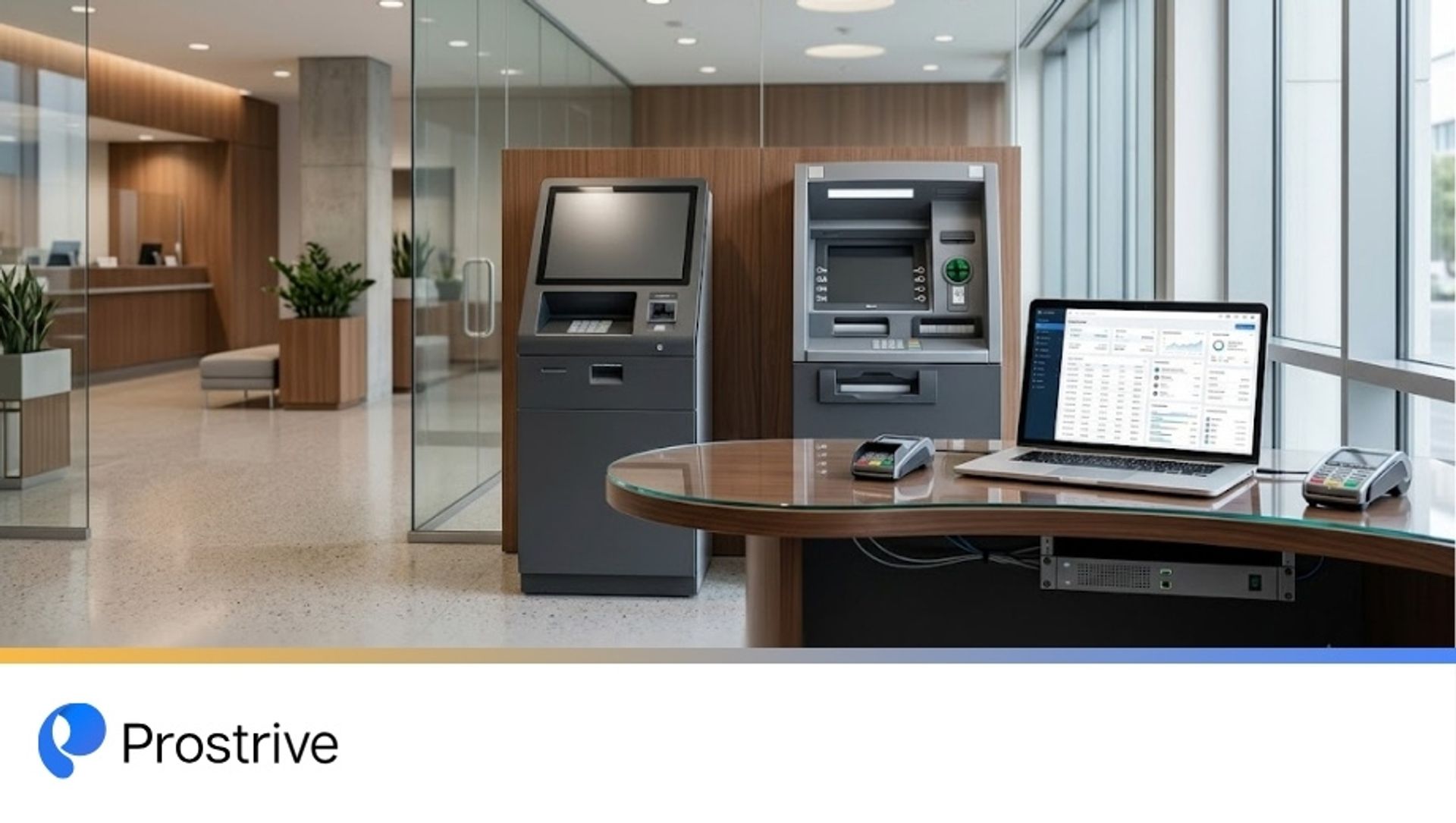
Core banking software works by running every transaction through one central ledger that all channels read from and write to. The word core stands for Centralised Online Real-time Environment, meaning one ledger for the whole bank rather than one per branch. Between the moment a customer confirms a payment and the moment the balance changes everywhere, the request passes through five steps.
What Happens Between Tapping Pay and the Balance Updating
The clearest way to understand a core banking system is to follow a single payment through it. The same five steps apply to a card purchase, a wire transfer and a loan repayment. Only the rules and the downstream systems differ.
Step 1: The Channel Sends the Request
The journey starts wherever the customer is: a mobile app, a web portal, an ATM or a teller screen. The channel does not decide anything. It packages the instruction, the account identifiers, the amount and the session context, then sends it to the core through an API.
This is why a well-built app cannot mask a slow core. The channel is waiting for an answer it cannot produce itself.
Step 2: The Core Authenticates and Applies the Rules
Before any money moves, the core establishes who is asking and whether they are allowed to ask. That covers session authentication, account entitlements, available balance, daily and per-transaction limits, sanctions screening and a real-time fraud score.
Order matters here. I would rather see a payment rejected in this step than reversed after posting, because a reversal touches the ledger twice and every downstream system has to be told about both entries.
Step 3: The Ledger Posts the Entry
Once the checks pass, the core writes the entry and updates the balance. This is the moment the money has actually moved, and it happens exactly once, in one place.
Double-entry accounting keeps both sides in step: every debit has a matching credit. The posting is immutable, so a correction becomes a new entry rather than an edit of the old one. That is what makes the ledger auditable years later.
Step 4: Downstream Systems Pick It Up
The posting triggers work that the customer never sees. The general ledger updates, the audit trail records who did what and when, and reconciliation confirms that the bank's records match the counterparty's.
If the payment leaves the bank, the core hands it to the relevant rail: a card network, SEPA, SWIFT or a domestic real-time scheme. Each rail has its own message format, cut-off times and settlement cycle.
Step 5: The Confirmation Travels Back
The response climbs back up through the API layer to the channel that asked. The customer sees a confirmation, and the new balance appears in the app, at the ATM and on the branch screen at the same time.
All five steps run in a fraction of a second, around the clock. Availability is measured in seconds of downtime per year, not hours, which is why upgrades have to happen while the system keeps serving traffic.
The Three Layers That Carry That Request
Banking software is usually organised into three layers, each with a distinct job. Getting that separation right is the foundation of any banking software development project, because it decides what you can change later without touching the ledger.
The core engine holds the ledger, balances, interest calculations and product logic. It is the single source of truth. The middleware, or API layer, connects that engine to everything else: fraud checks, identity verification, payment gateways, credit bureaus and partner platforms. The channel layer covers the interfaces customers and staff actually touch.
Older cores were built as one monolithic application, which is simpler to reason about but forces a full redeployment for any change. Modern platforms split the same functions into independent services that communicate over APIs. You trade some operational complexity for the ability to update a payment module without redeploying the ledger.
Building banking software?
We build digital banking platforms, core banking integrations and mobile banking apps for banks and FinTechs.
Explore banking software developmentWhat the Core Handles and What Connects to It
Not everything in a bank belongs in the core. Deciding which capabilities sit inside the ledger and which sit around it is the first structural choice in any FinTech software development project, and it shapes every integration that follows.
The core itself owns account management, deposits and withdrawals, transaction posting, interest and fee calculation, loan servicing schedules, the general ledger and regulatory reporting data. These are the functions that must never disagree with each other, so they live in one system.
Around that sit the systems most people think of as banking software. Payment engines handle the rails and the PCI DSS scope for card data. Mobile and web applications present live balances pulled through the API layer. Lending platforms manage origination, underwriting and credit decisioning, then write repayments back to the core. Fraud engines score transactions in real time and block them before posting.
Compliance follows the same split. Identity verification, document checks and ongoing AML screening run in dedicated KYC software rather than inside the ledger, and feed a verdict back to the core. In my view that separation is not optional. Compliance rules change on a regulator's timetable, and you do not want a rule change to mean a ledger release.
Core, Channels and the Orchestration Layer in Between
Three terms get used interchangeably and they are not the same thing. A core banking system is the ledger, built for accuracy and stability. A digital banking platform is the front end, built for the customer experience.
Between them sits orchestration: the layer that holds process state, entitlements and customer context across channels. It is what allows someone to start an application on a phone and finish it in a branch without repeating themselves.
Most of the architectural pain comes from that middle layer being missing. Teams then push process logic into the app, where it has to be rebuilt for every channel, or into the core, where it makes the ledger harder to change. The cost surfaces on the second channel, which repeats work the first one already did. I would rather spend a week deciding where the state lives than a quarter unpicking it later.
Where the Software Runs: On-Premises, Cloud or Hybrid
The same architecture behaves differently depending on where it is deployed, and this is a live decision rather than a settled one.
On-premises deployment keeps the system on servers the institution owns. It gives maximum control over data location and access, which simplifies some regulatory conversations, but scaling means buying and installing hardware.
Cloud deployment moves that burden to the provider. Capacity changes in minutes, updates arrive continuously, and disaster recovery is a configuration rather than a second data centre. In exchange, the bank takes on vendor concentration risk and has to present its controls to regulators, which in the UK means satisfying the Financial Conduct Authority on operational resilience and exit planning.
Hybrid is the common middle ground. Sensitive workloads and the ledger stay on-premises while customer-facing services scale in the cloud. The cost is orchestration: two environments that have to stay consistent with each other.
Why Legacy Cores Make Change Expensive
Most established banks are not running the architecture described above. They are running a core built decades ago, often in COBOL on a mainframe, designed around batch processing rather than real-time posting.
That design still handles enormous volumes reliably. The problem is everything around it. Batch cycles mean balances settle at fixed times rather than instantly. Business logic accumulated over decades is frequently undocumented, and the people who wrote it have retired. According to Boston Consulting Group, banks spend between 15 and 20 per cent of their total IT budget simply keeping these systems running.
There are four routes out, and they are not equally risky. Replatforming moves the existing code to modern infrastructure with minimal change. Refactoring restructures the codebase in place. Augmenting runs a modern core alongside the old one and migrates products across gradually. Full replacement swaps the platform outright.
Augmenting is the route I would argue for in most cases. It lets you prove the new core on a single product before betting the deposit book on it. The work that gets underestimated is the inventory, because a legacy core is usually wired to hundreds of peripheral systems, and every one of those connections has to be mapped, rebuilt and tested before anything can be switched off.
The Stack Behind a Modern Core
A modern core banking stack is built for throughput, traceability and controlled change. Backend services are commonly written in Node.js or Python, with the ledger on a database that supports strict transactional guarantees.
Event streaming through Kafka or Redis Streams carries postings to downstream systems without coupling them to the core. Docker and Kubernetes let individual services scale and recover independently. WebSockets push balance and status updates to channels the moment they change.
Security is structural rather than an added layer: encryption in transit and at rest, multi-factor authentication, role-based access control and immutable audit logging. The same applies to compliance, with PSD2, GDPR and PCI DSS shaping how data is handled long before a feature is designed. Observability sits alongside all of it, because in a system posting thousands of entries a second, you need to detect a problem before reconciliation does.
How We Build Banking Software at Prostrive
The hard part of banking software is rarely the interface. It is the ledger, the integrations and the migration path, and those are the parts that punish a team learning on the job.
We work as an extension of your team rather than a distant vendor. Our engineers join your standups, your Slack channels and your roadmap, so you keep control of the architecture while we add capacity where it is thin. Recent builds include FiatGate, a white-label non-custodial exchange, and Globus Payments, an EMI-licensed payments platform based in London.
If you are planning a new platform or modernising an existing core, we are happy to look at your architecture with you.


